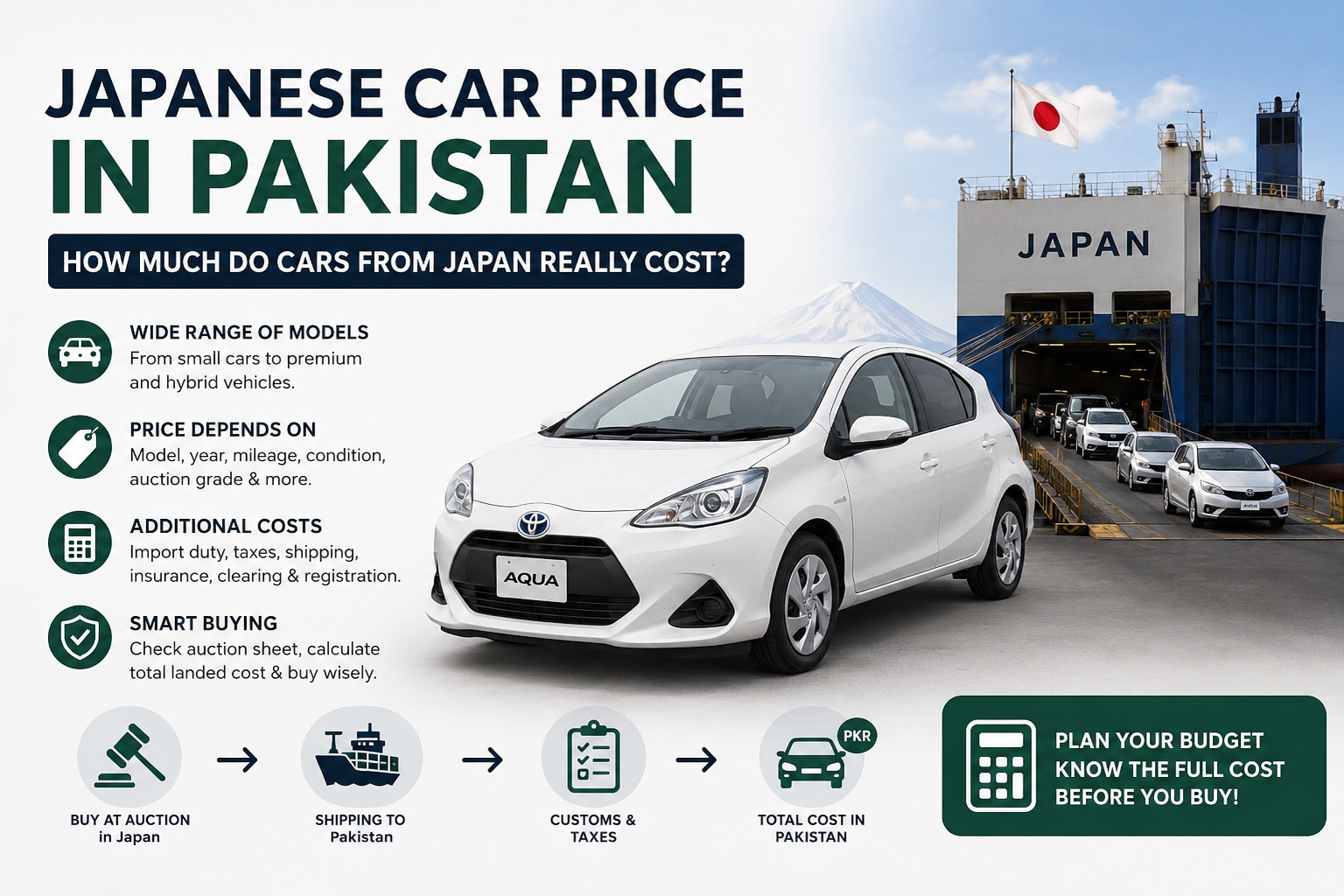
Japanese cars have become a familiar sight on Pakistani roads, particularly among buyers seeking fuel efficiency, modern features, dependable engineering, and strong resale value. From compact kei cars to popular hybrids and hatchbacks, cars from Japan occupy a substantial portion of the imported used-car market. However, understanding the actual Japanese car price in Pakistan requires more than checking an advertisement. The final figure can be influenced by the model, year, auction grade, engine capacity, exchange rate, shipping, customs duties, taxes, registration, and local market demand.
What Determines the Price of a Japanese Car?
The price of a Japanese import begins well before the vehicle reaches Pakistan. Buyers may encounter a Japanese auction price, an export price, a landed cost, or a dealer’s final retail price. These figures are not interchangeable.
A vehicle purchased at auction in Japan may appear remarkably affordable, but freight, insurance, port charges, customs duties, taxes, documentation, and other expenses can substantially increase the final amount. Consequently, someone comparing cars from Japan should calculate the complete landed cost rather than focusing exclusively on the purchase price in Japan.
Typical Japanese Car Prices in Pakistan
Current market listings demonstrate how widely prices can vary. For example, used Toyota Vitz models can range from approximately PKR 12.6 lakh to PKR 48 lakh, depending heavily on year, mileage, variant, and condition.
Other commonly imported models occupy different price brackets. Recent market estimates place Toyota Aqua models around PKR 25–45 lakh, Toyota Prius models around PKR 28–55 lakh, and Daihatsu Mira models around PKR 13–26 lakh. These should be treated as indicative ranges rather than fixed prices because auction grade, mileage, battery condition, specifications, and market availability can shift the valuation considerably.
Why Auction Grade Matters
One of the most important factors affecting the Japanese car price in Pakistan is auction grade. Japanese auction houses inspect vehicles and provide information concerning condition, mileage, repairs, interior quality, exterior defects, and other characteristics.
A higher-grade vehicle with a clean history generally commands a premium. Conversely, a repaired or accident-history vehicle may cost substantially less. The cheaper option is not necessarily the better bargain, however. Structural repairs, flood exposure, poor-quality repainting, or mechanical deterioration can eventually generate expenses that eclipse the original saving.
For this reason, buyers should scrutinize the auction sheet and verify its authenticity before committing money.
Shipping and Other Import Expenses
The price paid for a vehicle in Japan is only one component of the total import equation. Shipping from Japan to Pakistan, marine insurance, export documentation, port handling, clearing charges, and inland transportation can all contribute to the final landed price.
Customs duties and taxes are another major consideration. Pakistan’s current tariff structure changed from July 2026, with customs duty rates varying according to engine capacity and vehicle category. For example, current tariff information shows a 30% customs duty for certain vehicles up to 850cc and 35% for certain 850–1000cc vehicles, while additional duties and taxes can also apply.
Therefore, estimating the Japanese car price in Pakistan without considering the applicable tax structure can produce a misleadingly low figure.
Small Japanese Cars Can Offer Strong Value
Small-engine Japanese imports remain attractive because they combine compact dimensions with impressive fuel economy. Vehicles such as the Daihatsu Mira, Suzuki Wagon R, Toyota Vitz, and similar models appeal to urban drivers who prioritize economical commuting.
Recent market data places Japanese Wagon R models around PKR 15–24 lakh and Daihatsu Mira Turbo examples around PKR 18–28 lakh, although actual prices vary according to specification and condition.
For buyers working with a modest budget, these cars can provide a practical entry point into the imported Japanese market.
Hybrid Cars Have a Different Cost Equation
Hybrid vehicles such as the Toyota Aqua and Prius are particularly popular because of their fuel efficiency. Yet buyers should examine the hybrid battery carefully. A vehicle with an aging or deteriorated battery may initially look inexpensive but require significant expenditure after purchase.
The Aqua, for instance, can command a considerable premium over smaller conventional hatchbacks. Current market estimates place Toyota Aqua models broadly around PKR 25–45 lakh, while later or better-equipped examples can move beyond that range.
Battery health, mileage, auction grade, trim level, and model year should therefore be considered together when evaluating the price.
Direct Import vs Buying Locally
There are two broad approaches. A buyer can arrange an import from Japan or purchase an already-imported vehicle from a Pakistani dealer.
Direct importing can provide greater control over the vehicle’s auction grade, mileage, color, specification, and condition. It can also make the purchasing process more transparent when the exporter provides genuine auction documentation and a detailed cost breakdown.
Buying locally, meanwhile, is convenient because the vehicle is already in Pakistan and can usually be inspected and driven before purchase. However, the dealer’s margin, registration status, modifications, and previous usage can affect the final price.
Check the Complete Cost Before Buying
A sensible buyer should create a complete budget containing:
- Vehicle purchase or auction price
- Export and documentation charges
- Shipping and insurance
- Customs duties and applicable taxes
- Port and clearing expenses
- Registration and number-plate costs
- Transportation within Pakistan
- Possible maintenance or battery replacement
- Dealer or intermediary charges, where applicable
Pakistan’s Federal Board of Revenue also publishes vehicle-import requirements and duty structures, including provisions concerning eligible used vehicles under schemes such as Personal Baggage, Gift, and Transfer of Residence.
Final Thoughts
The real Japanese car price in Pakistan is ultimately a combination of purchase cost and ownership-ready cost. A car that looks cheap at the Japanese auction may become expensive after shipping, taxation, registration, and repairs, while a carefully selected higher-grade vehicle can deliver better long-term value.
For anyone considering cars from Japan, the most prudent approach is to compare the complete landed cost, authenticate the auction sheet, inspect the vehicle’s history, assess mechanical and hybrid-system condition, and account for current Pakistani import regulations. When these elements are evaluated together, Japanese imports can offer an appealing balance of quality, efficiency, practicality, and resale potential.
